PART II / CHAPTER 6 / WINNERS FAR FROM HOME
The fog returned late in the morning.
Nobody argued with it anymore.
The Navigator watched the route ahead disappear.
Then checked the chart.
“Harbour to starboard.”
The Captain raised the Spyglass.
White.
“How far?”
“Close enough.”
They turned.
The port was larger than the previous ones.
Ferries.
Cargo.
Hotels.
Roads disappearing inland.
They tied up before noon.
The fog closed behind them.
DAY ONE
By now, nobody needed instructions about an afternoon ashore.
The fog had given them time.
They used it.
The crew scattered.
The Scout’s ankle was still strapped. He could walk, though more slowly than usual.
A friend had invited the Scout to a special event in Madrid.
He took the high-speed train inland.
By late afternoon, he was standing outside Santiago Bernabéu.
Something was happening.
Not a match.
That was the strange part.
Crowds were moving towards the stadium.
Families.
Television crews.
Children in shirts.
People holding phones above their heads.
The Scout asked someone what was happening.
“A new player.”
“When's the match?”
The man looked at him.
“There isn't one.”
The Scout looked at the crowd again.
Thousands of people were entering a football stadium to watch someone who was not going to play football.
He followed them.
Inside, the stadium behaved as if something enormous were about to happen.
Music.
Screens.
Cameras.
Sponsors.
Shirts.
The player appeared.
The crowd rose.
Phones went into the air.
The player waved.
Held up the shirt.
Walked onto the grass.
Kicked a ball a few times.
The crowd roared.
Then it was over.
The Scout stayed in his seat.
A man beside him was already showing somebody the shirt he had bought.
“Does this happen every time?”
The man laughed.
“Not like this.”
The Scout looked towards the pitch.
The player had not played a minute.
Yet the stadium had filled.
Television had come.
Sponsors had come.
Merchandise had moved.
Global attention had moved.
Something had already happened economically before the thing the player had supposedly been hired to do had begun.
The Scout wanted to understand that.
He kept asking.
One conversation led to another.
Eventually he found himself speaking with Real Madrid's commercial director.
The Scout started with the obvious question.
“How valuable can a player be before he plays?”
The commercial director smiled.
“You're assuming the football is the whole business.”
That was where the conversation changed.
They talked about players.
Then the stadium.
Then audiences.
Media.
Sponsors.
International markets.
Entertainment.
Property.
Land.
Attention.
The Scout kept trying to bring the conversation back to football.
The commercial director kept leaving it.
At one point the Scout asked which other football clubs Real Madrid considered its most important commercial competitors.
The answer surprised him again.
Football clubs mattered.
Of course.
But commercially, the competition was much larger.
Global entertainment.
Media.
Disney.
Anything competing for the same attention.
The Scout looked back through the stadium.
“So the match is one part of the product.”
The director smiled.
“Now you're asking a better question.”
The Scout returned to the ship late.
Supper had already started.
The Engineer looked at him.
“Worth it?”
“Yes.”
“Good match?”
“There wasn't one.”
The Engineer stopped eating.
“You went to a football stadium without football?”
“That is exactly the problem.”
The Scout sat down.
The Captain waited.
He told them the story.
The presentation.
The full stadium.
The shirts.
The cameras.
The sponsors.
The conversation afterwards.
Football that kept turning into something else.
When he finished, the Engineer looked unconvinced.
“They bought a famous player.”
“Yes.”
“That does not seem particularly disruptive.”
“No.”
The Scout looked at his notes.
“That isn't what bothered me.”
The Observer leaned forward.
“What did?”
“The player had already started creating value before doing the thing they bought him to do.”
Nobody spoke for a moment.
The Captain looked at him.
“Keep going.”
The Scout did.
Real Madrid played football against other football clubs.
But commercially, the club competed for global attention.
The stadium was not only where matches happened.
It could become a stage.
Players were not only sporting resources.
They could become global brands.
The visible operation could create value somewhere else entirely.
The Navigator looked at him.
“So why do they win differently?”
That took longer.
They argued.
Removed things.
Put them back.
The Engineer kept returning to the player.
The Observer kept removing him.
“That is what we can see.”
“Yes.”
“What makes it work?”
The Captain watched them struggle.
They had learned this lesson before.
The visible thing was rarely enough.
Eventually the Scout pulled a blank card towards him.
At the top he wrote:
REAL MADRID IT
Then beneath it:
WHY DO THEY WIN DIFFERENTLY?
The first answer changed the competitive field itself.
They did not have to define the commercial game as football clubs competing only with football clubs.
The second showed that the visible business could create the cash, access and attention that made another form of value possible.
The third had brought the Scout into the stadium in the first place.
Value could begin before the core operating contribution began.
The Engineer read the three.
“They're not football tricks.”
“No.”
“They would still mean something without football.”
The Captain looked at him.
“That matters.”
The Observer tapped the player-presentation note.
“If we copied this, we'd hold a big ceremony.”
The Scout laughed.
“And sell shirts.”
“And completely miss the point.”
The Navigator looked at the three underlying moves.
“So those are the things we need.”
“Keys?” said the Scout.
The Engineer shrugged.
“To what?”
“To why they are so hard to play against.”
The Captain picked up the card.
Not the player.
Not the stadium.
Not the shirt.
Not the visible manifestation.
The mechanism underneath it.
She wrote:
DISRUPTION FORMULA
The Scout looked at her.
“Formula?”
“If the visible thing changes but the mechanism still makes sense, perhaps.”
The Observer pointed at the card.
“Then we need more than one story before we know.”
The Captain nodded.
They had seen enough to recognise a possible new lens.
Not enough to trust it.
The Scout looked towards the fog outside.
“Tomorrow?”
Nobody needed the rest explained.
DAY TWO
The harbour was clear in the morning.
The water beyond it was not.
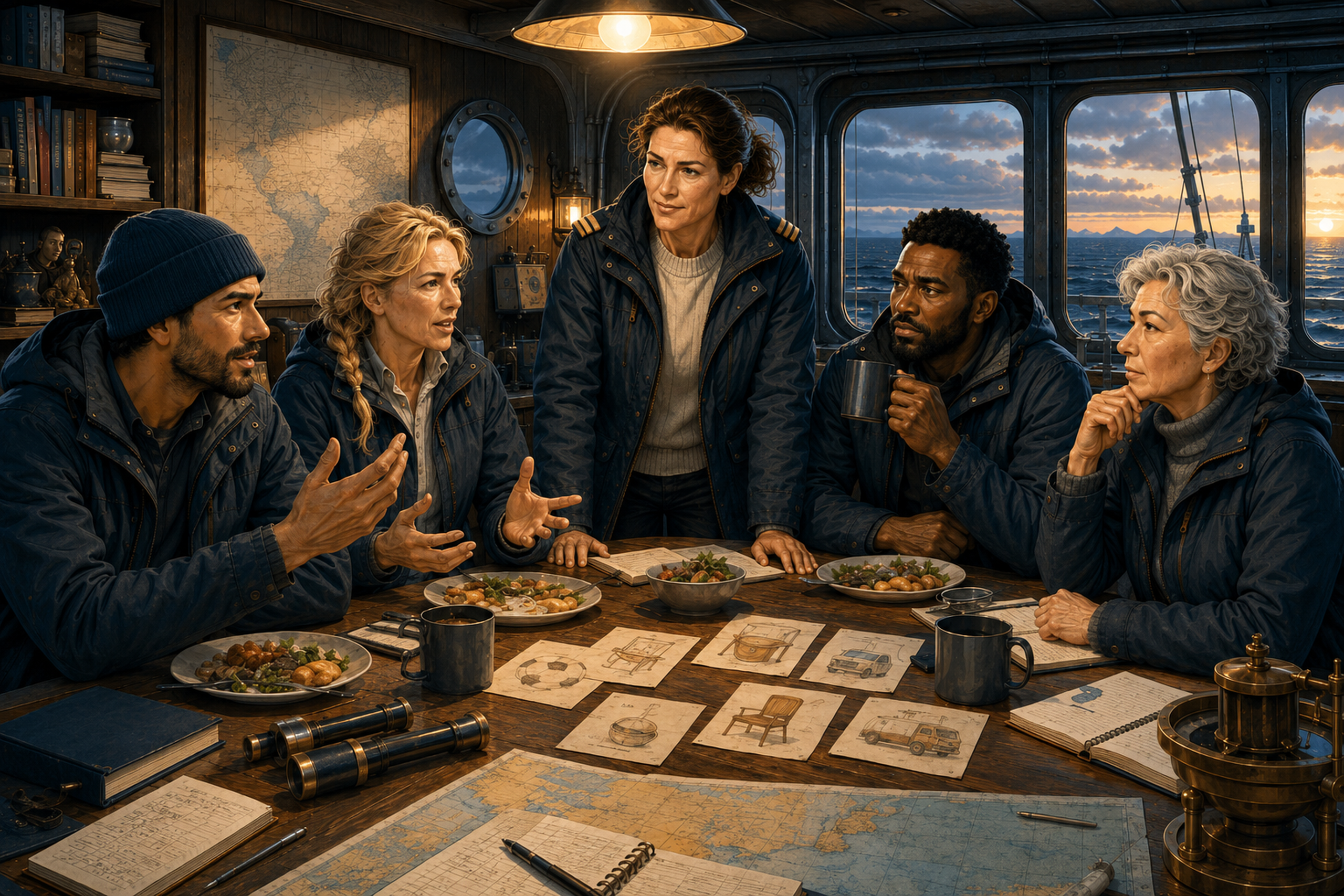
On the supper table, the Real Madrid card remained where they had left it.
Beside it were blank cards.
The Captain looked towards the Flag.
Then the Spyglass.
Then the crew.
“Find me winners their own competitors struggle to explain.”
The Scout smiled.
The Engineer picked up one of the blank cards.
“That is the whole Assignment?”
“No.”
The Captain took it back and wrote beneath it:
UNDERSTAND THE WHOLE WINNER STORY.
Then:
FIND THREE SPECIFIC MECHANISMS THAT EXPLAIN WHY THEY WIN DIFFERENTLY.
And finally:
KEEP THE MECHANISM. NOT THE MANIFESTATION.
The Navigator read them.
“And relevance?”
The Captain looked towards the Flag.
“Only after we understand the story.”
They made more Assignments.
Not sectors.
Ways of looking.
THE WINNER NOBODY CAN EXPLAIN
Find an organisation that competitors admire, copy or complain about, but still struggle to catch.
THE WRONG WAY TO WIN
Find a leader succeeding through something its own industry would once have called wrong, uneconomic or not the business.
THE COPY THAT FAILED
Find something competitors copied visibly without reproducing the advantage underneath it.
FAR FROM HOME
Look somewhere with as little resemblance to the Railway as possible.
The Engineer read the last card.
“That one was yours.”
The Scout looked pleased.
“Obviously.”
They divided the work.
The Scout wanted every Assignment.
He received two.
They went ashore.
They did not need to visit the companies themselves.
They needed people who understood their stories well enough to get beneath what everyone could already see.
Consultants.
Former employees.
Suppliers.
Customers.
Investors.
People who had competed against them.
People who had tried to copy them.
By midday, the stories were coming back.
NESPRESSO
The Engineer returned with coffee.
The Scout looked at the cup.
“You're becoming predictable.”
“That's part of the story.”
The coffee industry had known excellent coffee long before Nespresso.
Beans.
Roasting.
Espresso machines.
Baristas.
None of that explained the difference.
The Engineer put an imaginary machine between them.
“You can teach every customer to become good at making espresso.”
He moved his hands around the imaginary system.
“Or you can put much of the expertise inside the system.”
Machine.
Capsule.
Fit.
Quantity.
Serving.
The intended result became difficult to get wrong.
Then the relationship changed.
Nespresso did not simply wait for supermarkets or cafés to own the customer.
It built the relationship directly.
And when capsules became easier to copy, it shifted again.
Boutiques.
Membership.
Luxury.
Experience.
George Clooney.
The Scout smiled.
“That survives coffee.”
“Exactly.”
The Engineer put three short lines on the card.
Not generic lessons.
Mechanisms.
IKEA
The Observer returned with a catalogue.
The Engineer looked disappointed.
“We know IKEA.”
“That may be the problem.”
Everyone knew the catalogue.
Furniture.
Prices.
Rooms.
Inspiration.
The Observer had found someone who described it differently.
An operating artefact.
Change the catalogue and stores changed.
Exhibitions.
Availability.
Stock priorities.
The concept itself.
Then the flat pack.
Not simply cheaper packaging.
Transport changed.
Storage changed.
Warehouse density changed.
And the customer finished part of the factory job.
Finally, something even less visible.
Furniture had once behaved much more like a long-life household investment.
IKEA changed the economics enough to change the frequency of purchase.
The category moved.
The Engineer pointed at the flat pack.
“So that's the key.”
“No.”
The Observer shook her head.
“That's what everybody copies.”
She pointed beneath it.
“The change in where the work happens.”
The Captain nodded.
The formula had to survive IKEA.
McDONALD'S
The Navigator brought the last story they would follow closely.
She began with hamburgers.
Nobody let her continue.
“Property,” she said.
That got their attention.
Restaurants were the visible operation.
Underneath sat a system of locations, ownership and franchise economics.
The operation could create the traffic and cash flows around assets whose value compounded somewhere else.
Then another mechanism.
When others cut and retreated, an organisation with the strength to keep investing could use the downturn itself to become stronger.
And another.
Extreme consistency.
The Big Mac should not surprise you.
Experiment around the edges.
Protect the promise at the centre.
The Scout looked at the notes.
“Property. Countercycle. Consistency.”
“They barely belong together,” said the Engineer.
“And yet they reinforce one winner,” said the Observer.
That mattered.
A Disruptor did not need one trick.
The mechanisms could live in completely different parts of the business.
Ownership.
Capital.
Operations.
Customer role.
Distribution.
Brand.
Timing of value.
Definition of competition.
The combination was the story.
THE OTHER STORIES
The crew kept searching.
Gaming.
Luxury.
Insurance.
Logistics.
Technology.
Manufacturing.
Some companies were remarkable.
Some were enormously successful.
Some had excellent stories.
But success alone was not enough.
The crew became stricter.
“Customer focus.”
Rejected.
“Innovation.”
Rejected.
“Strong brand.”
The Scout did not even finish writing it.
Any organisation could claim those.
A useful mechanism had to retain something strange and specific from the story that produced it.
One conversation changed their discipline again.
The Observer returned from someone who had spent years watching competitors imitate an extraordinary winner.
“They copied almost everything they could see.”
“And?” asked the Navigator.
“It still didn't work.”
“Why?”
“They copied the manifestation.”
The Engineer leaned forward.
“But not why it worked.”
The Observer nodded.
That was the distinction.
The Captain wrote three questions where everyone could see them.
WHY DO THEY WIN DIFFERENTLY?
WHAT ARE THE THREE MECHANISMS THAT MAKE THAT DIFFERENCE WORK?
DO THOSE MECHANISMS SURVIVE OUTSIDE THE INDUSTRY THAT PRODUCED THEM?
They kept searching.
Then the Captain added the final test.
COULD THIS CONCEIVABLY MATTER TO OUR CHALLENGE?
Not:
How can the Railway use it?
Not:
What should we build?
Not:
Which station could copy it?
Only whether the Formula could conceivably belong in the material from which a future might later be made.
Some extraordinary stories failed that test.
They left them behind.
Others survived with only a maybe.
That was enough.
The future did not exist yet.
Forcing an application now would only invent one.
The Engineer tried anyway.
He placed one IKEA mechanism beside an Unfair Advantage.
The Captain separated them.
“Not yet.”
“But I can see something.”
“Good.”
“So?”
“Remember it.”
She returned the cards to their places.
The Scout smiled.
“Keep the Key.”
The Captain looked at him.
“Don't build the door yet.”
That stayed.
By late afternoon, the table was crowded.
Far more cases than the four they would ultimately carry forward.
Then something began to change.
New company.
Different industry.
Different manifestation.
Familiar underlying mechanism.
A new business built expertise into a system.
They already had a stronger example.
Another changed where work happened.
Already there.
Another redefined its competitive field.
Already there.
Another used a visible operation to create value somewhere unexpected.
Already there.
The Scout came back with no new card.
The Engineer looked almost concerned.
“Nothing?”
“Great company.”
“No story?”
“Excellent.”
“No mechanisms?”
“Three.”
“Then where's the card?”
The Scout pointed towards the table.
“We already have this pattern. Better.”
It happened again.
Then again.
They had not found every extraordinary winner.
They never would.
But searching farther was increasingly adding examples rather than changing what they could see.
The Captain looked at the cards that had survived.
Real Madrid.
IKEA.
McDonald's.
Nespresso.
Four very different worlds.
Four stories whose mechanisms remained strange enough to disturb familiar thinking.
The Navigator placed the Domain Orthodoxy collection beside them.
“We asked what a domain believes has to be true.”
The Captain nodded.
“And these?”
“These show winners behaving as if some part of their industry's obvious truth was optional.”
Not always.
Not perfectly.
But often enough to matter.
The Observer looked across the four cards.
“What do we call the lens?”
The Engineer tried first.
“Successful companies.”
“No.”
“Winners.”
“Too broad.”
The Scout looked at Real Madrid again.
“They don't just win the game.”
He looked at IKEA.
“They change part of how the game works.”
Nespresso.
“They make the old definition of the game less useful.”
McDonald's.
“And competitors have to play against a system they did not design for.”
The Observer looked at him.
“They disrupt the industry.”
The Scout smiled.
“Industry Disruptors.”
The name stayed.
INDUSTRY DISRUPTORS
Not because every one destroyed an industry.
Not because every incumbent disappeared.
Because each revealed an organisation that had learned to lead by playing important parts of its game differently enough that competitors found the resulting system difficult to match.
The Captain looked at the complete cards.
Each carried the story.
Each carried three DISRUPTION FORMULAS.
Not detached slogans.
Not generic advice.
Specific mechanisms whose meaning depended on understanding where they came from.
She drew a line beneath the selected four.
No qualification funnel.
No Remarkable.
No Actionable.
No Provocative.
That was not what these were.
They had been selected because the stories were strong, the mechanisms were specific, and they could conceivably disturb how the Expedition later thought about its Challenge. The canonical Part II amendment preserves exactly that distinction.
The Scout looked at the other cards.
“What about those?”
“Keep the records.”
“And these four?”
The Captain looked at the Challenge.
“Carry them forward.”
The Scout found a wooden box among the ship's stores.
The Engineer watched him put the four cards inside.
“You could use a folder.”
“I could.”
There was room behind them.
The Observer noticed.
“For more.”
“Later,” said the Captain.
The Scout looked disappointed.
“We're hearing ourselves coming back.”
He looked at the unused space again.
Then closed the box.
Outside, the fog still covered the harbour entrance.
The Engineer looked through the window.
“Do not say it.”
The Scout was already smiling.
DAY THREE
The Engineer was first on deck.
That annoyed him most.
The fog had not disappeared.
It had moved.
The harbour entrance was open.
Beyond it, a clear passage stretched towards another pale bank farther out.
The Captain joined him with the Spyglass.
The Navigator brought the chart.
The Observer carried the box.
The Scout came last.
“Well?”
The Engineer refused to answer.
The Captain raised the Spyglass.
Clear water.
Enough to move.
The Navigator traced the route.
“There's shelter before the visibility closes again.”
“How much margin?”
“Enough.”
The Captain lowered the Spyglass.
“Then we sail.”
The Navigator marked the port.
Beside it she wrote:
INDUSTRY DISRUPTORS
Four ports were now marked behind them.
Four different lenses.
UNFAIR ADVANTAGES
Things outsiders could see in the Railway that the Railway itself barely noticed.
DOMAIN ORTHODOXIES
Beliefs familiarity had made appear inevitable.
PAINS & PRIORITIES
Things people struggled with, tolerated, worked around and protected when forced to choose.
And now:
INDUSTRY DISRUPTORS
Winner stories from elsewhere, with mechanisms explaining how leaders had learned to play differently enough to make them unusually difficult to compete with.
The Captain looked at the chart room.
It was becoming crowded.
That was new too.
At the beginning, the problem had been not knowing where to look.
Now they had the opposite problem.
They had learned how to find.
How to turn an accidental experience into a lens.
How to turn a lens into deliberate Assignments.
How to search until new encounters mostly returned what they already knew.
And how to stop without pretending they had found everything.
The Scout looked at the box.
“Think the Railmaster will like these?”
The Engineer laughed.
“He'll hate them.”
“Even better.”
The Captain did not open the box.
Not yet.
The four cases were not futures.
They were not strategies.
They were not instructions to copy anybody.
They were proof that apparently fixed games could be rearranged.
Soon the Expedition would have to decide what among everything they had found actually deserved to matter.
But that was not this port's lesson.
The lines were released.
The ship moved through the harbour entrance.
Behind them, the port disappeared.
Ahead, the clear passage narrowed towards fog.
For now, there was enough sea to continue.