PART II / CHAPTER 7 / WHAT MATTERS
The fog returned before they reached another port.
The Navigator found the nearest harbour on the chart.
The Captain did not turn towards it.
The Scout noticed.
“No harbour?”
“No.”
He looked ahead.
There was nowhere useful to sail.
Behind them were the searches they had already made.
Ahead was white.
“So we wait?”
The Captain looked through the chart-room door.
“We work.”
The Scout followed her gaze.
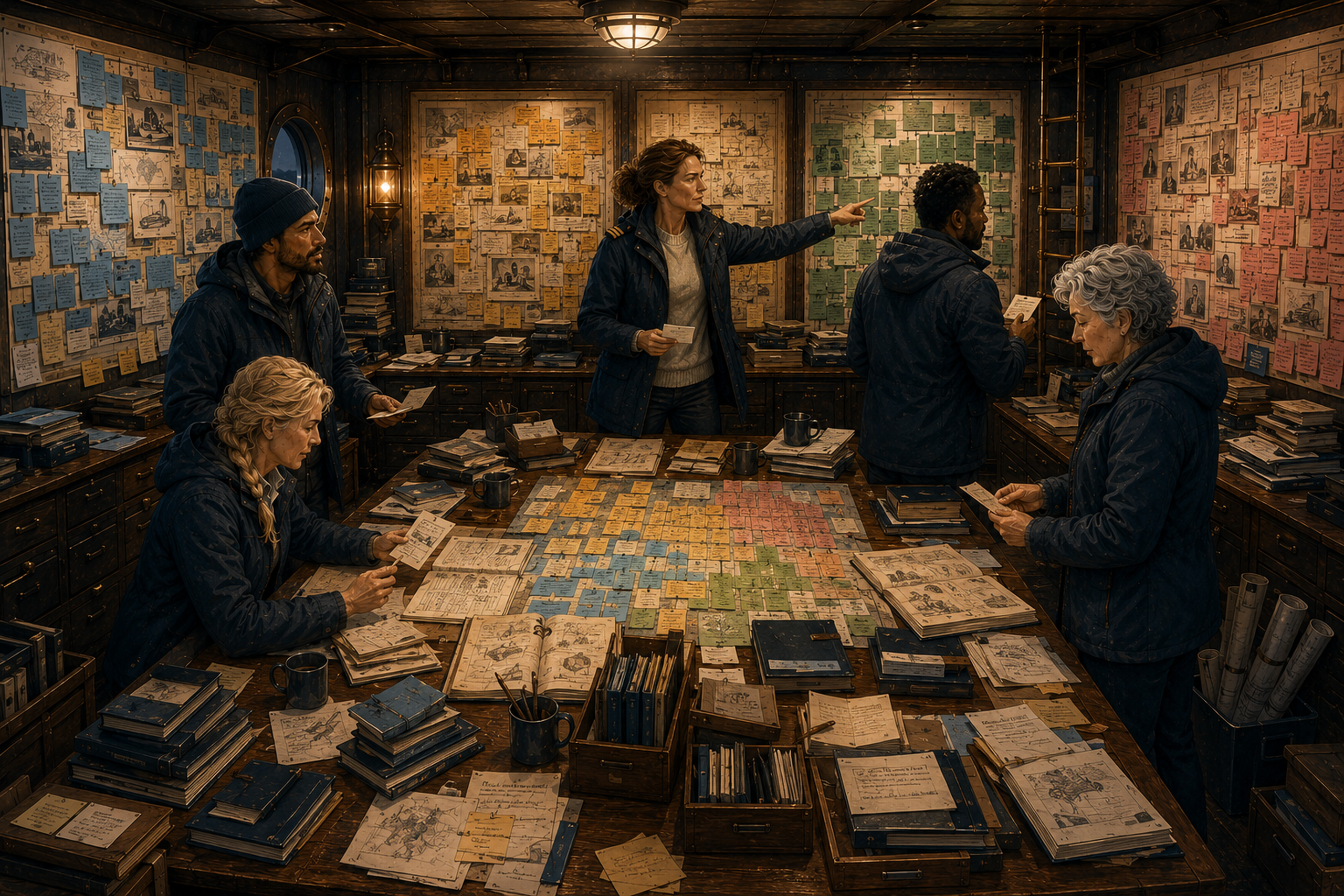
The room had become almost unusable.
One wall carried UNFAIR ADVANTAGE DISCOVERIES.
Another carried DOMAIN ORTHODOXY DISCOVERIES.
Across from them were PAINS & PRIORITIES DISCOVERIES.
The INDUSTRY DISRUPTOR INSIGHTS sat apart.
Those had arrived differently.
The crew had first found the Disruptor.
Then understood the story well enough to identify the principles underneath how it won.
The DISRUPTION FORMULAS.
Once they had found the Formulas, they had the Insight.
No further polishing made a Formula more true.
The rest of the chart room was different.
Discoveries everywhere.
Not yet Insights.
Around them were notebooks.
Maps.
Photographs.
Fragments of conversations.
Names.
Questions.
The table had disappeared beneath it all.
Boxes occupied the floor.
The Scout stood in the doorway.
“We need a bigger room.”
“No,” said the Captain.
He looked around.
“We definitely need a bigger room.”
“We need less.”
That was harder.
Until now, the Expedition had rewarded curiosity.
Look again.
Ask again.
Follow another lead.
Keep searching until another encounter mostly changes the example rather than the picture.
Now the Captain picked up one card.
“We cannot take all of this home and call it Insight.”
The Scout leaned against the door.
“Why not?”
“Because most of it isn’t.”
He looked at the walls again.
“Back home, how will they know?”
“Know what?”
“That we chose the right ones.”
The Captain did not answer immediately.
The people at Central Station had not stood on the shores with them.
They had not heard the conversations.
They had not watched the hospital smokers.
They had not seen what the crew had seen through other people's eyes.
And they would not have time to repeat the Expedition before deciding what to do with what came home.
The Engineer looked towards the door.
“They will have to trust us.”
“Yes,” said the Captain.
The Scout folded his arms.
“That we turned every stone?”
“That we looked hard enough.”
“That we did not keep something just because we liked it?”
“Yes.”
“And that we did not throw something away because it was inconvenient?”
“Yes.”
The Navigator looked at the walls.
“So how do we make them trust our judgement?”
The Captain picked up a card.
“By making every one of these earn its place.”
The Scout looked around the room again.
Not everything they had discovered could travel home.
Some of it was true but ordinary.
Some of it was interesting but inert.
Some of it might matter and still disappear the moment it met the noise of the Railway.
The question had changed.
Not:
What did we discover?
But:
WHAT DESERVES TO TRAVEL WITH US?
DAY ONE
They began with a simple question.
The Captain held up an Unfair Advantage Discovery.
“If you heard this at supper tonight, would you tell anyone tomorrow?”
The Scout read it.
“Maybe.”
“That means no,” said the Observer.
“It’s true.”
“Nobody said it wasn’t.”
“It’s interesting.”
“So are thousands of things.”
The Observer picked up another Discovery.
It came from the later conversation with the industrial operator.
The note was plain:
AN INDUSTRIAL OPERATOR ENVIES OUR PRACTICAL PROBLEM-SOLVING BECAUSE OUR PEOPLE START FIXING THINGS BEFORE MOST LARGE COMPANIES HAVE DECIDED WHO OWNS THE PROBLEM.
Everyone remembered the vessel.
The missing tool.
The steel bracket.
The pipe.
The clamps.
The skipper asking:
“How did you know how?”
And the Engineer answering:
“Railway.”
The Observer looked at the card.
Then wrote a new title.
RAILWAY KNOW-HOW JUST FIXED A SHIP.
The Engineer smiled.
“I’ve already told that one twice.”
“So have I,” said the Navigator.
The Observer wrote one word on the board.
REMARKABLE
Underneath she wrote:
WORTH TELLING SOMEONE.
The Scout frowned.
“That’s it?”
“That’s enough.”
“What if it’s important but boring?”
“Then find what is actually worth telling.”
“And if there isn’t anything?”
The Captain took the card from him.
“Out.”
The Scout winced.
“So Remarkable means dramatic?”
“No,” said the Observer. “It means not generic. Not fluffy. Not something we could have written before we sailed.”
“Fresh?”
“Yes.”
“Distinct?”
“Yes.”
“Worth repeating?”
“Yes.”
The Engineer picked up another card.
“This could be true of almost every railway company in the world.”
“Then what does it tell ours?” asked the Captain.
The Engineer looked at it again.
“Not much.”
“And if every player in the Domain could say the same thing?”
“It gives us nothing they could not use too.”
The Observer took the card from him.
“Worse. Because it sounds familiar, we may not even remember it when it matters.”
The Captain pointed to the board.
“If you would not tell someone, why would we take it home?”
The Scout looked at the word again.
“Remarkable.”
“Something new enough to earn space in our heads,” said the Navigator.
“And in theirs,” said the Captain.
They worked through the Discoveries.
Some already had something in them.
A contradiction.
A fresh way of seeing the Railway.
Something outsiders envied that the Railway barely noticed.
A Priority that changed how a Pain should be understood.
An Orthodoxy so familiar nobody inside the Domain could hear it anymore.
Others did not.
They tried better titles.
Shorter titles.
Sharper titles.
Sometimes the Discovery suddenly came alive.
Sometimes the title merely made a weak thought sound clever.
Those went out too.
“Same Discovery,” said the Captain.
“Better title.”
The Scout nodded.
“Not a better invention.”
“Exactly.”
By midday, a large pile had stopped.
The Engineer looked at it.
“Harsh.”
“No,” said the Navigator.
“Useful.”
They moved to the survivors.
The Engineer picked one up.
“This is worth telling.”
“Good,” said the Captain.
“What can anyone do with it?”
The Engineer paused.
The Scout answered first.
“Tell someone.”
“That was the last gate.”
The Scout frowned.
The Observer laughed.
The Engineer tried again.
“What can become different because we know this?”
The room went quiet.
That question changed the card.
The Navigator wrote the second word.
ACTIONABLE
Underneath:
SOMETHING CAN BE DONE ABOUT IT.
The Captain picked up the Railway repair card.
The title was memorable.
RAILWAY KNOW-HOW JUST FIXED A SHIP.
But what could anyone do with it?
The crew went back to what had happened.
The ship had not needed a Railway.
It had needed a habit the Railway had produced.
People who did not wait for perfect instructions when something practical failed in front of them.
People who knew how to improvise safely with what was available.
The Engineer tried a new title.
OUR RAILWAY KNOW-HOW WORKS WHERE THERE ARE NO TRACKS.
The Scout read it again.
“That gives me ideas.”
“Such as?”
The Scout looked at him.
“You said we weren’t making futures yet.”
“We aren’t.”
“Then don’t make me.”
The Captain smiled.
“That is the point.”
They did not need the idea yet.
They needed an Insight that could become something tangible later.
Used.
Applied.
Built upon.
Combined.
Challenged.
Turned into something.
If the crew could do nothing with it except admire it, it was not ready.
A Remarkable Discovery could still be useless.
The chart room could be filled with fascinating truths and still leave the Railway exactly where it was.
The Engineer looked at the growing pile beside the door.
“Ballast.”
The Captain nodded.
“If it cannot help anyone change, build, avoid, combine, challenge or do something differently, why carry it?”
Those went out.
The pile shrank again.
By late afternoon, the Scout had stopped defending cards because he liked the story attached to them.
The Observer stopped defending cards because she had travelled far to find them.
The Engineer stopped defending cards because the facts were technically correct.
The Navigator stopped defending cards because somebody important had said them.
None of those things made them Actionable.
The Captain held up another survivor.
“Worth telling?”
“Yes.”
“Could something tangible come from knowing it?”
“Yes.”
She left it on the table.
“For now.”
The Scout stared at her.
“There’s another one?”
“Yes.”
“How many ways can a Discovery die?”
“Three.”
“That’s comforting.”
DAY TWO
By morning, two words dominated the board.
REMARKABLE
ACTIONABLE
The third space was still empty.
The Captain returned to the hospital card.
The original observation had survived easily:
PEOPLE SMOKE UNDER THE NO SMOKING SIGNS.
Nobody forgot it.
Remarkable.
Then they had found what could be done with it.
The problem was not merely that smokers ignored signs.
The hospital had made prohibition obvious and the acceptable choice almost invisible.
That could be changed.
Actionable.
The Observer wrote a title.
DESIGN THE CHOICE, NOT JUST THE RULE.
The Engineer nodded.
“Useful.”
The Scout did not.
“Would you tell anyone?”
“Yes.”
“Would they do something with it?”
“Probably.”
“Would they care?”
The Engineer looked at him.
“It’s a smoking area.”
“Exactly.”
The Scout leaned back.
“Central Station has a hundred things more urgent than a smoking area.”
The Captain looked at the card.
That was the problem.
Back home, their Insights would not arrive in an empty room.
They would arrive beside delayed trains.
Broken signals.
Budgets.
Shifts.
Targets.
Customers.
Everything that already mattered today.
Being true did not guarantee attention.
Being useful did not guarantee attention.
A Discovery could be worth telling.
Something could be done with it.
And still nobody had to care.
Not enough to stop.
Not enough to listen.
Not enough to reflect.
Not enough to move.
Not enough to survive everything else demanding attention.
The Scout looked towards the newspapers stacked by the chart table.
“News knows this.”
The Observer followed his eyes.
“The stories that move people make them feel something.”
“Not just shock,” said the Captain.
“No.”
“Attention.”
“Care.”
“Movement.”
The Observer looked back at the hospital notes.
Signs everywhere saying what people could not do.
No obvious place showing what they could do.
People trying to comply.
People failing.
Then being treated as the problem.
She took a fresh card.
At the top she wrote:
OUR HOSPITAL HATES SMOKERS.
The Engineer laughed.
“That’s unfair.”
“Do you care?”
He stopped laughing.
She continued.
“We tell them everywhere what they cannot do. We give them nowhere obvious where they can do it. Then we blame them for smoking under our signs.”
The Scout looked at the title again.
“I care now.”
The Navigator wrote the third word.
PROVOCATIVE
Underneath:
NOT EASY TO BE INDIFFERENT TO.
Then, after a moment:
WILL THIS MOTIVATE SOMEONE, URGE SOMEONE OR PROVOKE SOMEONE TO ACT? TO CARE?
The Captain read it.
“That’s the gate.”
The Engineer pointed at the hospital title.
“So Provocative means accuse someone?”
“No.”
“Shock them?”
“No.”
“Make it louder?”
“No.”
The Observer tapped the card.
“It means there is enough here that you cannot just shrug.”
The Navigator nodded.
“You may agree.”
“Disagree.”
“Laugh.”
“Get uncomfortable.”
“Want to fix it.”
“Want to argue with it.”
The Captain finished the thought.
“But indifference should be difficult.”
The Scout looked at the three words on the board.
“Remarkable.”
“Worth telling,” said the Observer.
“Actionable.”
“Something can be done about it,” said the Engineer.
“Provocative.”
“Make me care,” said the Navigator.
The Scout pointed at the hospital card.
“And the title does most of that.”
The Captain nodded.
That was the important part.
They had been treating the card as if every sentence had to perform.
It did not.
The title carried the Insight into the room.
The description could then do a quieter job.
Explain.
Clarify.
Show what the title meant.
Stay with the same Insight.
The Observer rewrote the hospital card in its finished form.
OUR HOSPITAL HATES SMOKERS.
The hospital has made prohibition visible everywhere while leaving the compliant choice almost invisible. People who want to obey still have no obvious place to go. When a system designs the rule but not the acceptable behaviour, it can end up blaming people for a choice the system itself failed to make possible.
The Scout read the title first.
Then the description.
“The title makes me care.”
“And the description?”
“Tells me what we mean.”
“Anything else?”
“No.”
“Good.”
One Insight.
Not a headline followed by three more Insights disguised as explanation.
The title had passed all three gates.
The description stayed underneath it.
They tried the same discipline on the other cards.
A weak title could hide a strong Discovery.
A clever title could hide a weak one.
They learned to tell the difference.
The Captain kept asking the same three questions.
Would you tell someone?
Can something be done with it?
Will it make someone care enough to react or act?
If the answer was no, they improved the title.
If the truth underneath could not carry a better title, the card stopped.
No fourth chance.
No score.
No committee.
No proof contest.
Improve it until it passes.
Or remove it.
By lunch, the process had become fast.
Not easy.
Fast.
A Pain & Priority card failed Remarkable.
They found the deeper Priority.
It passed.
A Domain Orthodoxy card passed Remarkable immediately.
It failed Actionable.
They changed the framing until the implication became tangible.
It passed.
Another was Remarkable and Actionable but left everyone flat.
They worked the title three times.
Still flat.
Out.
The Scout stared at the stopped pile.
“That one is true.”
“Yes.”
“And useful.”
“Yes.”
“But nobody cares.”
“Then it is not an Insight we carry.”
The Scout looked offended on the card’s behalf.
The Captain did not.
The Expedition had not sailed to protect Discoveries.
It had sailed to find what mattered.
THE OTHER ROUTE
After lunch, the Scout reached for the Industry Disruptor box.
“Now these?”
The Captain shook her head.
“They already took another route.”
The Observer opened the box.
Real Madrid.
Nespresso.
IKEA.
McDonald’s.
Each case had first been discovered.
Each story had been understood deeply enough to find the underlying DISRUPTION FORMULAS.
Those Formulas were the Insights.
The Scout pointed at the board.
“No Remarkable?”
“No.”
“No Actionable?”
“No.”
“No Provocative?”
“No.”
“That feels unfair.”
“It is different material.”
The Navigator picked up one of the Formulas.
“We are not improving an observation about ourselves, our Domain or a Persona.”
“We are identifying the transferable principle underneath how somebody changed the game,” said the Observer.
The Captain closed the box.
“They go forward as Industry Disruptor Insights.”
“And later?”
“Later, when we have opportunities or concepts, we can hold the relevant Disruptors against them.”
The Scout smiled.
“What would Nespresso do with it?”
“Later.”
“What three things would they hurry to implement before we got it back?”
The Captain looked at him.
“Exactly.”
He put the card down.
“For once, I’m early.”
“Yes.”
The box stayed closed.
DAY THREE
The fog was still there when they woke.
The Scout looked offended by that too.
The chart room looked different.
Most of the cards were gone from the table.
Not discarded.
Accounted for.
Some had failed Remarkable.
Some could not become Actionable.
Some remained too easy to ignore.
The survivors were smaller in number.
Stronger in title.
Quieter underneath.
Each had one job.
The Captain picked up a finished Unfair Advantage Insight.
She read only the title.
“Remarkable?”
“Yes.”
“Actionable?”
“Yes.”
“Provocative?”
“Yes.”
Then she read the description.
“Same Insight?”
“Yes.”
Another.
A Domain Orthodoxy.
Title first.
Then description.
Another.
A Pain & Priority.
Title first.
Then description.
The Scout noticed what she was doing.
“You always start with the title.”
“If the title doesn’t carry it, the Insight arrives too late.”
“What if the explanation is brilliant?”
“Then use it to find the title.”
They continued.
Not every finished card was short.
Not every title was clever.
Some were almost plain.
But none were generic.
None were merely interesting.
None were inert.
None were easy to ignore.
That was enough.
The Engineer kept the original Discoveries and source notes in the Expedition Record.
Not because the Insight needed to win a trial.
Because someone might later need to understand where it came from.
The Captain did not make traceability another gate.
The three gates were enough.
The record simply kept the journey intact.
By midday, every UA, DO and PP Discovery had a place.
Improved into an Insight.
Or stopped at a known gate.
The Industry Disruptor Insights sat beside them.
Four lenses.
Two routes.
One Insight set.
The Scout picked up one of the finished cards.
“So this is what we ask them to build from?”
“If it survives what comes next,” said the Captain.
He turned the card between his fingers.
“It feels like a key.”
The Engineer looked up.
“A key to what?”
“Something we could not open before.”
The Navigator looked at the stopped piles.
“And the ones we left behind?”
The Scout followed her gaze.
“Doors we do not need to open.”
The Captain shook her head.
“Not forever.”
She pointed to the Expedition Record.
“Out does not mean false. It means not strong enough to shape this future, from this Challenge, on this Expedition.”
The Observer nodded.
“So we keep the record.”
“Yes.”
“But we do not carry every Discovery into what we build next.”
“No.”
The Scout looked at the card again.
“A good Insight opens something.”
“And closes something,” said the Engineer.
“A route we no longer need.”
“A generic answer.”
“An inert truth.”
“A direction nobody will care enough to follow.”
The Captain took the card from him.
“Perhaps.”
“Perhaps?”
“These are Insights.”
She placed it with the others.
“Keys have another test before we call them Key Insights.”
The Scout sighed.
“Of course they do.”
The Captain looked at the neat stacks on the table.
“When the Railway builds from what we bring home, they must be able to trust two things.”
She touched the surviving Insights.
“That these earned their place.”
Then the Expedition Record.
“And that what we left behind was left behind deliberately.”
The Scout counted what remained.
“Is that all?”
The Observer looked at the room they had emptied.
“No.”
He turned.
“We travelled all that way for these?”
“We travelled all that way so we could know it was these.”
The line landed differently now.
The walls were mostly clear.
The boxes had shrunk.
The table could be seen.
On it sat:
UNFAIR ADVANTAGE INSIGHTS
DOMAIN ORTHODOXY INSIGHTS
PAINS & PRIORITIES INSIGHTS
And beside them:
INDUSTRY DISRUPTOR INSIGHTS
The Scout looked towards the Treasure chest.
“Now?”
The Captain shook her head.
“They are Insights.”
“Yes.”
“They survived.”
“The first three survived Qualification. The fourth came by another route.”
“So they go in?”
“No.”
“Why?”
“Because being strong enough to carry forward is not the same as deciding which ones matter most.”
The Scout looked at the chest.
Still empty.
“What happens next?”
The Captain looked at the Insight cards.
“Someone else gets to take them.”
The Scout frowned.
“Take them where?”
The Captain almost smiled.
“Pirates.”
He stared at her.
Outside, the fog began to move.
The Navigator opened the shutters.
A strip of clear water appeared.
The Captain looked once more at the board.
REMARKABLE
Worth telling someone.
ACTIONABLE
Something can be done about it.
PROVOCATIVE
Not easy to be indifferent to.
Three gates.
No scores.
No proof contest.
Improve until it passes.
Or remove it.
The Engineer closed the Expedition Record.
The Observer straightened the Insights.
The Navigator marked their position.
The Scout looked at the Treasure chest one last time.
Empty.
Then the Captain turned out the light.
By morning, the Pirates would have the cards.